 Add to Chrome
 Add to Firefox
 Add to Edge
DynSess: Dynamic Session-Level Evaluation and Optimization Framework for Role-Playing Agents
May 28, 2026
Role-playing with large language models is fundamentally a session-level task, requiring agents to sustain character identity and interaction quality across extended multi-turn conversations. Yet existing evaluation and optimization methods remain largely turn-level, failing to capture long-horizon quality. We propose DynSess, a unified session-level framework for role-playing agents. DynSess-Eval scores complete dialogue sessions via rubrics targeting long-horizon behaviors. Leveraging its session-level rewards, we construct high-quality training trajectories through multi-turn lookahead search and train DynSess-Character with two complementary variants: DSPO (off-policy) and GSRPO (on-policy). Experiments show that DynSess-Eval aligns with human judgments substantially better than prior evaluators, and blind human evaluation further shows that DynSess-Character matches the strongest character model despite using substantially fewer parameters, while maintaining strong role consistency and interactive ability. Our dataset and code will be released to facilitate future research.

From Facts to Insights: A Persona-Driven Dual Memory Framework and Dataset for Role-Playing Agents
May 25, 2026While role-playing agents excel in short-term interactions, long-term conversations overwhelm context windows, motivating external memory frameworks. Current systems typically rely on persona-agnostic summarization, which records facts without persona-specific interpretation, yielding generic responses that compromise persona fidelity. To bridge this gap, we introduce RoleMemo, a dataset featuring four reasoning tasks where the factual fragments must be interpreted through the persona to reach the correct answer. Evaluation on RoleMemo exposes critical limitations of persona-agnostic frameworks. We thus propose DualMem, which decouples memory into two streams: factual cognition and persona-conditioned insight. Trained through Supervised Fine-Tuning (SFT) and Reinforcement Learning (RL), our framework with a 4B-parameter model outperforms zero-shot persona-agnostic frameworks powered by DeepSeek-V3.2 for sustained persona fidelity. Our resources are available at https://github.com/role2026/rolememo.
Preferences Order, Ratings Anchor: From Fused Expert Aesthetic Ground Truth to Self-Distillation
May 20, 2026Pairwise preferences and pointwise ratings are the two dominant annotation protocols in image aesthetic assessment (IAA), yet existing benchmarks adopt only one, leaving their complementarity unmeasured under controlled conditions. We introduce PPaint, a matched dual-protocol benchmark in which 15 domain experts, 5 per category, annotate 150 Chinese paintings under both protocols across five aesthetic dimensions, collecting 45,900 pairwise expert judgments through a locally dense preference design alongside the matched ratings. The matched design reveals complementary strengths: preferences yield more consistent ordinal rankings, while ratings anchor the absolute score scale. Fusing both signals via two independent preference-to-score methods yields a fused expert ground truth on which the two constructions converge to nearly identical scores. The same preference-to-score principle extends to label-free VLM training. PSDistill converts VLM pairwise judgments into calibrated pseudo-scores via an Elo reference pool, and trains the same VLM with confidence-weighted ranking optimization to produce a single-pass aesthetic scorer. Trained on a single painting category, the distilled Qwen3-VL-8B improves mean SRCC from 0.504 to 0.709 across all three categories, outperforming all open-source baselines including the dedicated aesthetic model ArtiMuse and matching closed-source Gemini-3.1-Pro within 0.04 SRCC at single-pass inference cost, with cross-domain transfer further validated on APDDv2. We will release the full PPaint dataset and training code.
Persistent Story World Simulation with Continuous Character Customization
Mar 17, 2026Story visualization has gained increasing attention in computer vision. However, current methods often fail to achieve a synergy between accurate character customization, semantic alignment, and continuous integration of new identities. To tackle this challenge, in this paper we present EverTale, a story world simulator for continuous story character customization. We first propose an All-in-One-World Character Integrator to achieve continuous character adaptation within unified LoRA module, eliminating the need for per-character optimization modules of previous methods. Then, we incorporate a Character Quality Gate via MLLM-as-Judge to ensure the fidelity of each character adaptation process through chain-of-thought reasoning, determining whether the model can proceed to the next character or require additional training on the current one. We also introduce a Character-Aware Region-Focus Sampling strategy to address the identity degradation and layout conflicts in existing multi-character visual storytelling, ensuring natural multi-character generation by harmonizing local character-specific details with global scene context with higher efficiency. Experimental results show that our EverTale achieves superior performance against a wider range of compared methods on both single- and multi-character story visualization. Codes will be available.
Empowering Economic Simulation for Massively Multiplayer Online Games through Generative Agent-Based Modeling
Jun 05, 2025Within the domain of Massively Multiplayer Online (MMO) economy research, Agent-Based Modeling (ABM) has emerged as a robust tool for analyzing game economics, evolving from rule-based agents to decision-making agents enhanced by reinforcement learning. Nevertheless, existing works encounter significant challenges when attempting to emulate human-like economic activities among agents, particularly regarding agent reliability, sociability, and interpretability. In this study, we take a preliminary step in introducing a novel approach using Large Language Models (LLMs) in MMO economy simulation. Leveraging LLMs' role-playing proficiency, generative capacity, and reasoning aptitude, we design LLM-driven agents with human-like decision-making and adaptability. These agents are equipped with the abilities of role-playing, perception, memory, and reasoning, addressing the aforementioned challenges effectively. Simulation experiments focusing on in-game economic activities demonstrate that LLM-empowered agents can promote emergent phenomena like role specialization and price fluctuations in line with market rules.
Ψ-Arena: Interactive Assessment and Optimization of LLM-based Psychological Counselors with Tripartite Feedback
May 06, 2025Large language models (LLMs) have shown promise in providing scalable mental health support, while evaluating their counseling capability remains crucial to ensure both efficacy and safety. Existing evaluations are limited by the static assessment that focuses on knowledge tests, the single perspective that centers on user experience, and the open-loop framework that lacks actionable feedback. To address these issues, we propose {\Psi}-Arena, an interactive framework for comprehensive assessment and optimization of LLM-based counselors, featuring three key characteristics: (1) Realistic arena interactions that simulate real-world counseling through multi-stage dialogues with psychologically profiled NPC clients, (2) Tripartite evaluation that integrates assessments from the client, counselor, and supervisor perspectives, and (3) Closed-loop optimization that iteratively improves LLM counselors using diagnostic feedback. Experiments across eight state-of-the-art LLMs show significant performance variations in different real-world scenarios and evaluation perspectives. Moreover, reflection-based optimization results in up to a 141% improvement in counseling performance. We hope PsychoArena provides a foundational resource for advancing reliable and human-aligned LLM applications in mental healthcare.
Crisp: Cognitive Restructuring of Negative Thoughts through Multi-turn Supportive Dialogues
Apr 24, 2025Cognitive Restructuring (CR) is a psychotherapeutic process aimed at identifying and restructuring an individual's negative thoughts, arising from mental health challenges, into more helpful and positive ones via multi-turn dialogues. Clinician shortage and stigma urge the development of human-LLM interactive psychotherapy for CR. Yet, existing efforts implement CR via simple text rewriting, fixed-pattern dialogues, or a one-shot CR workflow, failing to align with the psychotherapeutic process for effective CR. To address this gap, we propose CRDial, a novel framework for CR, which creates multi-turn dialogues with specifically designed identification and restructuring stages of negative thoughts, integrates sentence-level supportive conversation strategies, and adopts a multi-channel loop mechanism to enable iterative CR. With CRDial, we distill Crisp, a large-scale and high-quality bilingual dialogue dataset, from LLM. We then train Crispers, Crisp-based conversational LLMs for CR, at 7B and 14B scales. Extensive human studies show the superiority of Crispers in pointwise, pairwise, and intervention evaluations.
CharacterBench: Benchmarking Character Customization of Large Language Models
Dec 16, 2024

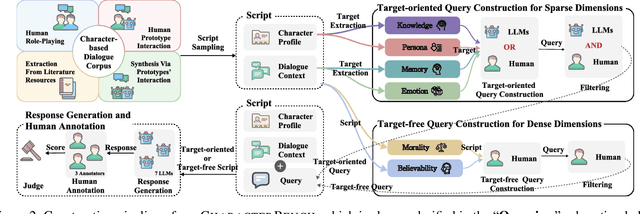

Character-based dialogue (aka role-playing) enables users to freely customize characters for interaction, which often relies on LLMs, raising the need to evaluate LLMs' character customization capability. However, existing benchmarks fail to ensure a robust evaluation as they often only involve a single character category or evaluate limited dimensions. Moreover, the sparsity of character features in responses makes feature-focused generative evaluation both ineffective and inefficient. To address these issues, we propose CharacterBench, the largest bilingual generative benchmark, with 22,859 human-annotated samples covering 3,956 characters from 25 detailed character categories. We define 11 dimensions of 6 aspects, classified as sparse and dense dimensions based on whether character features evaluated by specific dimensions manifest in each response. We enable effective and efficient evaluation by crafting tailored queries for each dimension to induce characters' responses related to specific dimensions. Further, we develop CharacterJudge model for cost-effective and stable evaluations. Experiments show its superiority over SOTA automatic judges (e.g., GPT-4) and our benchmark's potential to optimize LLMs' character customization. Our repository is at https://github.com/thu-coai/CharacterBench.
StoryWeaver: A Unified World Model for Knowledge-Enhanced Story Character Customization
Dec 10, 2024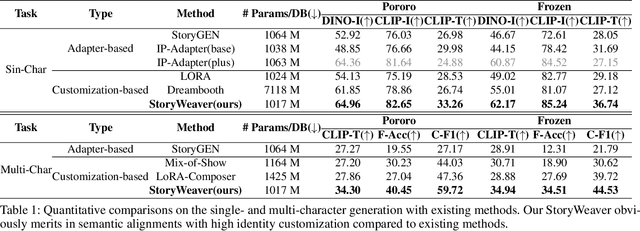
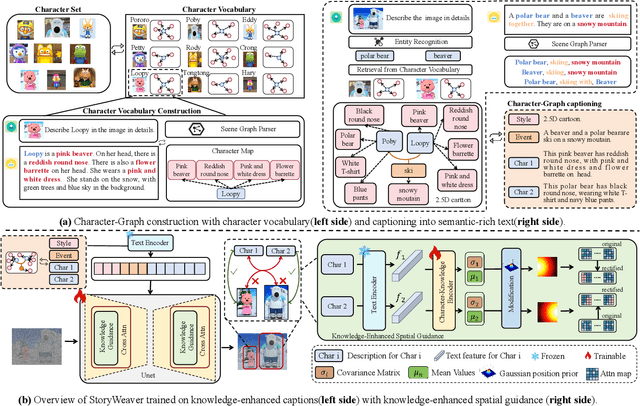
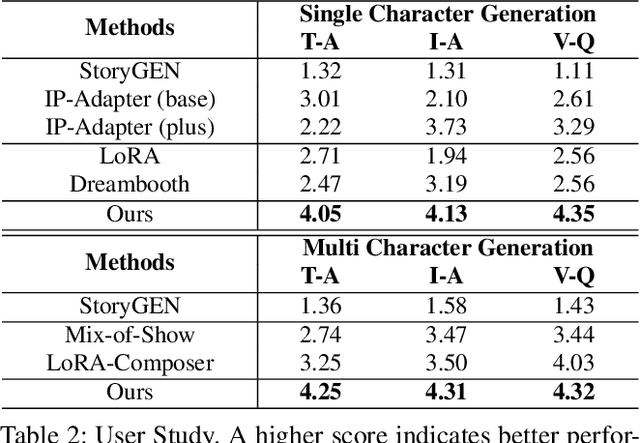

Story visualization has gained increasing attention in artificial intelligence. However, existing methods still struggle with maintaining a balance between character identity preservation and text-semantics alignment, largely due to a lack of detailed semantic modeling of the story scene. To tackle this challenge, we propose a novel knowledge graph, namely Character Graph (\textbf{CG}), which comprehensively represents various story-related knowledge, including the characters, the attributes related to characters, and the relationship between characters. We then introduce StoryWeaver, an image generator that achieve Customization via Character Graph (\textbf{C-CG}), capable of consistent story visualization with rich text semantics. To further improve the multi-character generation performance, we incorporate knowledge-enhanced spatial guidance (\textbf{KE-SG}) into StoryWeaver to precisely inject character semantics into generation. To validate the effectiveness of our proposed method, extensive experiments are conducted using a new benchmark called TBC-Bench. The experiments confirm that our StoryWeaver excels not only in creating vivid visual story plots but also in accurately conveying character identities across various scenarios with considerable storage efficiency, \emph{e.g.}, achieving an average increase of +9.03\% DINO-I and +13.44\% CLIP-T. Furthermore, ablation experiments are conducted to verify the superiority of the proposed module. Codes and datasets are released at https://github.com/Aria-Zhangjl/StoryWeaver.
StyleTalk++: A Unified Framework for Controlling the Speaking Styles of Talking Heads
Sep 14, 2024


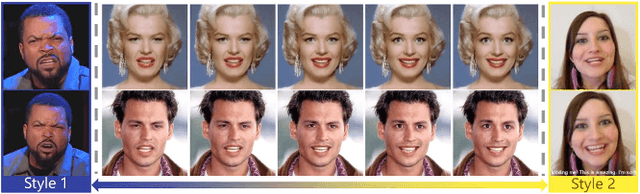
Individuals have unique facial expression and head pose styles that reflect their personalized speaking styles. Existing one-shot talking head methods cannot capture such personalized characteristics and therefore fail to produce diverse speaking styles in the final videos. To address this challenge, we propose a one-shot style-controllable talking face generation method that can obtain speaking styles from reference speaking videos and drive the one-shot portrait to speak with the reference speaking styles and another piece of audio. Our method aims to synthesize the style-controllable coefficients of a 3D Morphable Model (3DMM), including facial expressions and head movements, in a unified framework. Specifically, the proposed framework first leverages a style encoder to extract the desired speaking styles from the reference videos and transform them into style codes. Then, the framework uses a style-aware decoder to synthesize the coefficients of 3DMM from the audio input and style codes. During decoding, our framework adopts a two-branch architecture, which generates the stylized facial expression coefficients and stylized head movement coefficients, respectively. After obtaining the coefficients of 3DMM, an image renderer renders the expression coefficients into a specific person's talking-head video. Extensive experiments demonstrate that our method generates visually authentic talking head videos with diverse speaking styles from only one portrait image and an audio clip.